

 Find a book


Title
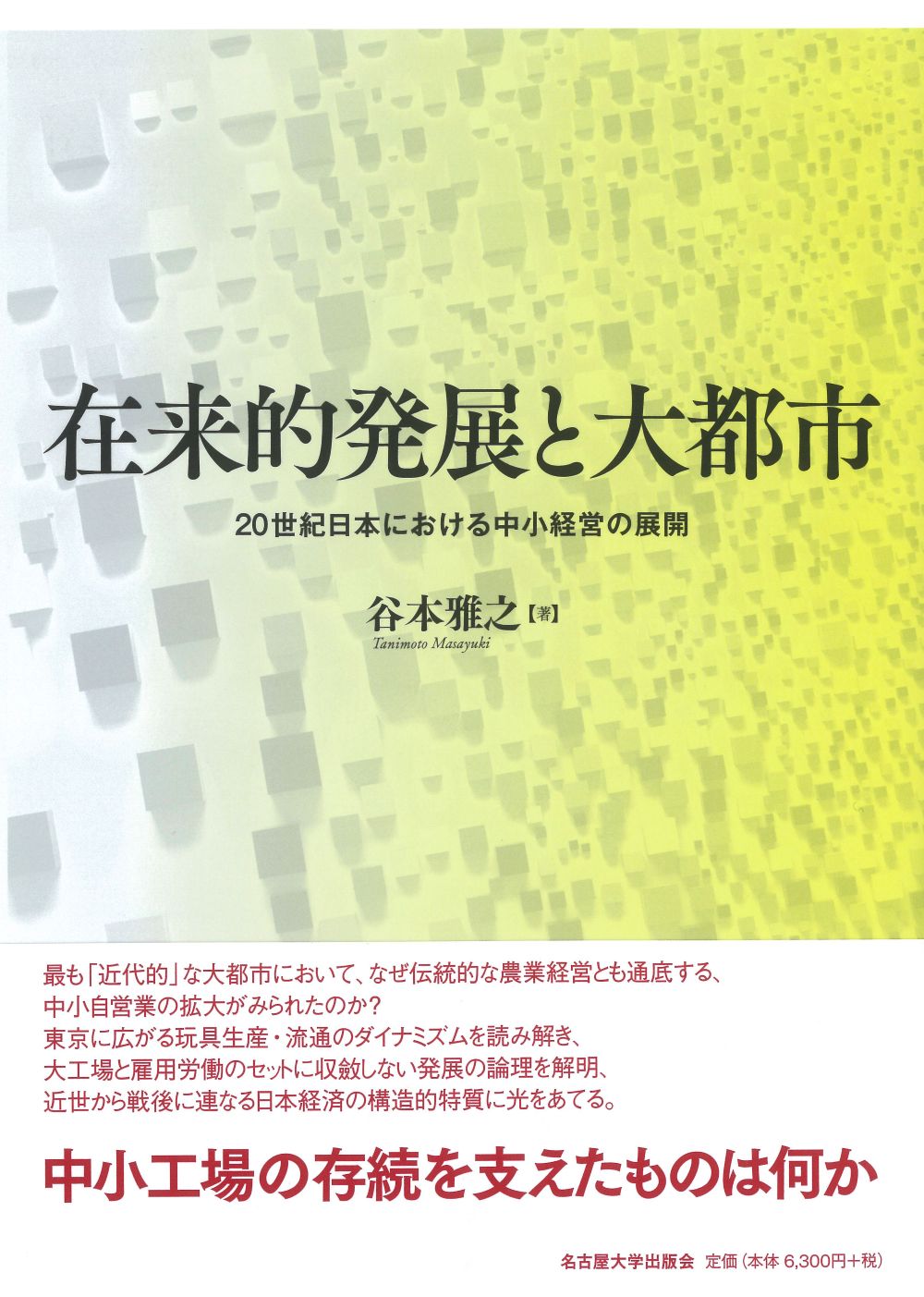
Zairaitekihatten to Daitoshi (Indigenous Development in the Metropolis - Small Businesses in the 20th Century Japan)
Size
424 pages, A5 format, hardcover
Language
Japanese
Released
February 29, 2024
ISBN
978-4-8158-1149-5
Published by
The University of Nagoya Press
Book Info
See Book Availability at Library
Japanese Page
It is safe to say that recent historical research on the Japanese economy generally agrees that the industrialization of modern Japan was driven not only by the transplantation and development of Western-style factory-based industry, but also by small and micro-sized factories and workshops. However, there is still debate over how to interpret the coexistence of business entities of such vastly different scales. The approach of viewing the process of economic modernization as a “dual economy” formed by “traditional society” and “modern society” has been widely accepted as an explanation for the realities faced by developing and late-developing countries. Under this perspective, there is a tendency to view the traditional sector—comprising small and micro-enterprises—either as a manifestation of backwardness or as an entity organized and utilized under the modern sector, namely the large-scale corporate sector. In contrast, the author, in his previous work, Indigenous Economic Development and the Weaving Industry in Japan (Nagoya University Press, 1998) argued—through an analysis of historical records from a weaving clothier (putters-out)—that the putting-out system with domestic production, which underpinned the development of the cotton weaving industry during the Meiji and Taisho periods (c. 1880–1925), was a production model in which the putting-out system was linked to the labour allocation strategies in the peasant, namely small scale faming, households. Even within the textile industry, which is said to have led the “Industrial Revolution,” there existed patterns of industrial development that did not necessarily lead to the establishment of the factory system; in my previous work, I referred to this as “indigenous economic development.”
The aim of this book is to empirically demonstrate, using the major city of Tokyo as a case study, that the scope of this theory of “indigenous development” extends to an investigation of the characteristics of Japan’s economic development in the 20th century. The focus on Tokyo is based on the fact that this modern metropolis, which had distanced itself the most from traditional peasant society, was simultaneously a place where small and medium-sized manufacturing enterprises were born and reproduced. In fact, these urban small and medium-sized enterprises were revitalized by the shared vision of a life course in which workers, after serving as apprentices, became skilled workers, and ultimately aimed to establish its own workshops through independent startup. Thus, entry into small and medium-sized enterprises involved a proactive response aimed at creating desirable employment opportunities.
However, for this to become a reality, the development of competitive industries based on small businesses is necessary. This book examines the toy industry—which used metal and celluloid as newly introduced materials—as a case study. This industry emerged in 1920s Tokyo as a new export industry targeting Western markets and expanded its production until around 1970. Parts II and III of this three-part volume are devoted exclusively to a historical analysis of this toy industry. International comparisons reveal that Japan’s toy industry exhibited a strong reliance on small and medium-sized enterprises (SMEs) even when compared with other major producing countries such as Germany, the United States, and the United Kingdom, as well as the post-World War II emerging economy of Hong Kong. It became clear that, under the leadership of organizations known as “producing organizer,” SMEs backed by skilled craftsmanship served as the primary agents of production, and that the urban environment of the metropolis of Tokyo supported this decentralized production structure by expanding the availability of technology and labor endowed in the industrial agglomerations.
The fact that this industrial pattern persisted from the 1930s through the postwar period of rapid economic growth and into the 1970s demonstrates that the scope of the “indigenous development” theory is surprisingly broad. If so, it seems essential to understand the economic development of modern Japan as a process of interaction between two distinct forms of economic development—each possessing its own unique logic—namely “modern” and “indigenous” development—a process of “multilayered development”. The final chapter concludes with this line of inquiry.
(Written by TANIMOTO Masayuki, Emeritus Professor, Graduate School of Economics / 2026)
Related Info
Awards for Studies on Small Business, Grand Prize in 2024 (Shoko Research Institute 2024)
https://shokosoken.or.jp/commendation/selected.html
https://shokosoken.or.jp/jyosei/kenkyu/kako-syourei.pdf
Book Review:
Reviewed by Asuka Imaizumi (Technology and Culture Volume 67, Number 1 January, 2026)
https://doi.org/10.1353/tech.2026.a980987