

 Find a book


Title
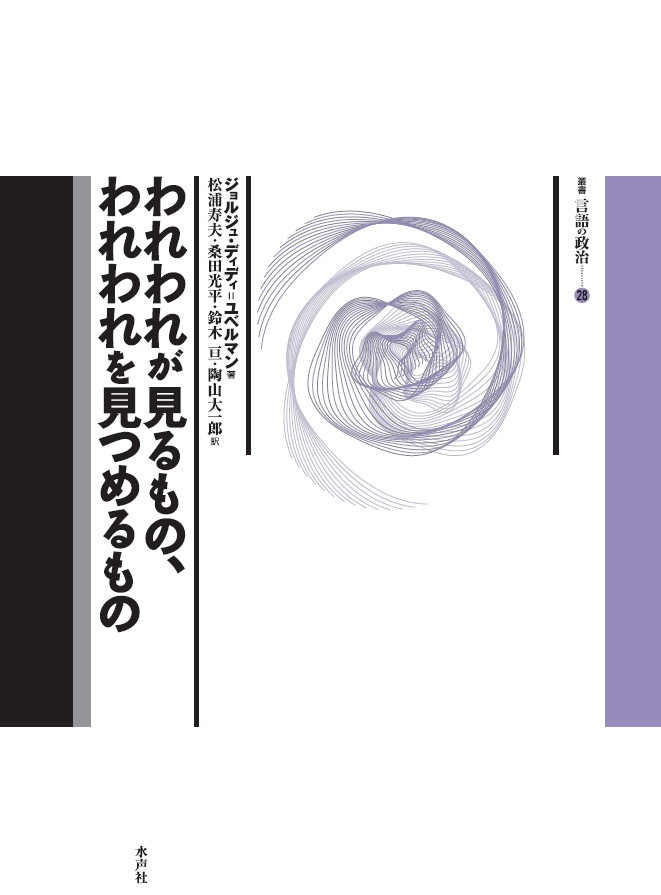
Politics of Language Series 28 Wareware ga miru mono, wareware o mitsumeru mono (What we see, what looks at us)
Size
342 pages, A5 format
Language
Japanese
Released
October, 2024
ISBN
978-4-8010-0719-2
Published by
Suiseisha
Book Info
See Book Availability at Library
Japanese Page
 eBook
eBook
This book is a Japanese translation of Ce que nous voyons, ce qui nous regarde (Minuit, 1992) by the French philosopher and art historian Georges Didi-Huberman who is known for his criticism of traditional art history discourse as framed by the likes of Vasari and Panofsky, and for his application of Warburgian iconology and psychoanalysis to delve more deeply into the fundamentals of imagery. While Didi-Huberman’s writings are numerous and cover a wide range of subjects, this book focuses on his writings on the minimal art of Tony Smith and others (with, of course, frequent references to concepts familiar to readers of Didi-Huberman—such as the methodological consciousness of “anachronism” and Walter Benjamin’s “dialectical image”).
The title clearly reflects the thesis of this book, which is that fundamental to the act of seeing is the sense that the images we “see” are in turn “looking back” at us. Images compel us, draw us in, perhaps even threaten us. The French verb regarder meaning “to look” also has the meaning of “to engage,” and Didi-Huberman focuses on this power of images in his discussions of minimal art. Take for example, Tony Smith’s work, Die (1962), which is nothing more than a six-foot (183 cm) black cube. Why are we drawn to this object that is “nothing more than a black cube,” and how does this happen?
In addressing these questions, it is notable that Didi-Huberman is critical of the various concepts and discourses put forth to date regarding minimal art. Such as, for example, the attempt by Donald Judd, who was both a minimal artist and art critic, to define minimal art as “specific objects” that reject the illusionism of traditional painting in favor of simple literalism. Likewise, the minimalist painter Frank Stella famously described his own work by saying, “What you see is what you see.” What Didi-Huberman points out is that this kind of rhetoric regarding minimal art is tautological. Rather, he argues that the artwork that looks back at us as we look at it appeals to our emotions with dialectical imagery that is inherently ambiguous and fluid.
(Written by SUZUKI Wataru, Assistant Professor, Graduate School of Humanities and Sociology / 2025)